Showing posts with label Eye Dazzler. Show all posts

Sunday, December 12, 2010

Curved Roofs and Other Feminine Things

If Modernism was all about cubes, rectangles, and angularity [here] then our new romanticism likely has to add in a curve or two or many.  And, this is one of the traits that will jump out at you as you drive or walk by the new romantic "postmodern" stuff.

One popular curve is called the Curved Roof or Arched Roof.  It is seen everywhere these days in corporate buildings, homes, and utilitarian structures.  Here are some examples. 

[1]. House


[2] Shed

[3] Shelter

 
[4] Office building.  Kinda looks like Donald Trump's hair.


So now that you get the picture, where else do we see these images and ideas?  How about the things we like to look at.  For example, in health clubs everywhere, the new image is curvy-ness (with or without muscles) as people want roundness not slimness and angularity. And the name Curves resonates with this.

[5] The Curves health club, note the circle training area.


The new goal for women is to just have nice looking curves such as enhanced butts, [6].  Hard to miss those curves.


The old Modernists liked to emphasize the chest with bullet bras, making triangles or pyramids [7].


Meanwhile economist and humorist Jodi Beggs promotes herself using romanticism.  And, of course, she claims to be interested in Behavioral Economics and public economics. No modernist her.  I suspect she wouldn't like a real Rational Man. Her logo [8]


And, of course, we have new eye dazzlers [9].  No need here to embellish an Apollonian base--it's pure right hemisphere Dionysian fun.


In today's America, the important lines of the body and the built environment are curved.


Notes


Saturday, November 6, 2010

Cubism: From Moderation to Excess

         The Progressive Era (aka the Third Awakening, ca. 1890-1920) was a great quest for order after decades of romanticism.  Modernism would sweep in behind it and dominate most of the twentieth century.  Let’s take a look at some of the key designs, ideas, and values of Modernism.  They basically include linearity, geometry, squares, and rectangles. Balance and equilibrium are also important ideas. 

      At the turn of the 20th century artist Pablo Picasso began a new art form called Cubism where “artworks, objects are broken up, analyzed, and re-assembled in an abstracted form—instead of depicting objects from one viewpoint, the artist depicts the subject from a multitude of viewpoints to represent the subject in a greater context. Often the surfaces intersect at seemingly random angles, removing a coherent sense of depth. The background and object planes interpenetrate one another to create the shallow ambiguous space, one of cubism's distinct characteristics” [1].  As typical in an Awakening, cubism was a hybrid style--Apollo abstracting Dionysus.  This gets inverted 75 years later.
    
                                                                       Picasso 1910
     
     Cubism was just one trend that was signaling that another Apollonian era was emerging.  That trend was Modernism with its love of straight lines and angles.  In Architecture the German Bauhaus school would soon put its stamp of order on the world.  Many of its practitioners would move to the US in the 1930s and influence designs here. See the design below. 

                        Johannes Itten, 'House of the White Man - Architectural Study' (1921) [2]

     After World War II, as the middle class began expanding, there was a need to build small inexpensive homes all across the nation.  Architects and urban planners began building planned suburbs such as Levittown, PA and the many Capehart and Wherry housing tracts on military installations.  The ranch style became one of the more popular home styles in the US.   These small, modest homes are all variations on cubes and rectangles. 


                                        Wherry style home, Elgin Air Force Base, CA. [3]

     During those years plaid clothing was common.  People also used phrases such as “he’s square,” “he’s straight,” and “He’s a straight shooter” to complement someone. (A straight person is honest and has integrity; a crooked person doesn't).  Later, during the Fourth Awakening and after, people who had once been complemented in such a manner would be criticized for being “uptight” because they were viewed as being overly controlled and “emotionally repressed.”  Loosen up man.

                                                                              Plaid shirt

     The closing years of Modernism saw a great deal of beautiful architecture that offered simple and elegant designs.  The glass office building with its repetition of cubes and rectangles was the high watershed of Modern architecture.  In every day puzzles, the Rubik’s Cube (aka Rubix cube) was the ultimate game.  Below we see some nice lines and geometry.

                                            Towers of Bella Terra, Orange County CA [4]

     Even before Postmodernism got moving in the 1980s there were some early examples of Dionysian excess.  One art style is called Op Art that uses simple Apollonian lines and geometry to create eye dazzlers.  Here is one piece by American artist Richard Anuszkiewicz.  The Op Art movement is typically viewed as being an outgrowth of the Bauhaus school.

                                                           Richard Anuszkiewicz 1961

     Currently much new Romantic architecture is basically about embellishing the Modernistic standard.  If glass buildings were elegant then they also need to become opulent with more detail and materials, and they need to be contextualized (mimicking feng shui) to their environment.  Here is the MacAllen Building & Condominiums in Boston MA, built circa 1999.  It is described in this way:

                                      MacAllen Building & Condominiums, Boston MA,1999

“On the western end, the building responds to the highway with a curtain wall yielding panoramic views for the residents inside the building. On the eastern end, brickwork mirrors that of the residential building fabric, extending the logic of the storefront and pedestrian scale elements on that facade. On the north and south facades, bronzed aluminum panels reflect the industrial neighborhood component and express the structural system organization.”[5]  I think it has a nice mild eye dazzler effect.

     “Often post-modern architecture is referred to as neo-eclectic, essentially representing a revival of period styles for houses, and an unending variety of forms and sleek, asymmetrical designs for commercial buildings. Post-modernism is based on several reactions: a rejection of modernist thought; a return to traditional, historical precedents; and a re-awakened interest in history and heritage.” [6]. 

     And often it is just unpleasant to look at—not because they are eye dazzlers, but because they are ugly cubicles and rectangles.  Eventually, our new Dionysian era will stop anchoring itself to Modernism.  When it does hopefully we will be inspired by new forms of beauty.  Meanwhile all I can do is try not to cringe at the sight of such crap as below. And this crap is being built all over the west coast. Please stop. 

                                                       Neo Eclectic Hotel, Fullerton, CA


This essay is now fairly popular.  Please also see:


Notes:


6. Quote and photo from http://www.fullertonheritage.org/Resources/archstyles/postmod.htm. Not all post modernism rejects Modernism; as I've been saying, it often embellishes it.

Sunday, October 24, 2010

Apollonian and Dionysian: A Visual Aid

     The two cultural patterns or cognitive narratives play out in many different ways.  Ruth Benedict identified the Puebloan cultures of North America as Apollonian while the rest of Native America was Dionysian [1]. 
      
     The basic Apollonian pattern is:  order, clarity, logic, moderation, and control.  The basic Dionysian pattern is:  spontaneity, passion, intuition, rebellion, and love of excess.  While a culture is a blend of both frames its artifacts often reveal which way the culture is leaning. In the yin and yang of sequences, the Dionysian often embellishes what the Apollonian has established as a standard.
     
      So let’s look at some classic Puebloan artifacts.  The Hopi are known for their beautiful polished silver items with simple geometric and angular patterns:

                                                               Hopi:  Man in Corn Maze
   

Hopi: Kachina Dancers

These are belt buckles, Man in Corn Maze and Kachina Dancers.  Symmetry is found in both but the Kachina buckle has five dancers instead of three pairs. The Corn Maize one is about as elaborate as the traditional Hopi wants to get. 
 
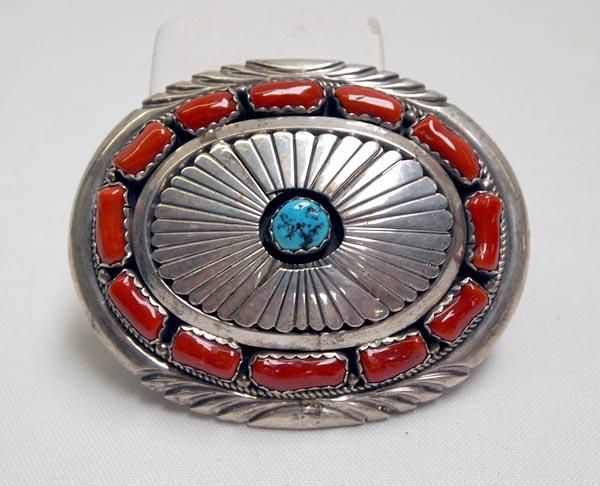
     The Navaho are neighbors to the Hopi. They are an Apachean group that did not live in pueblos and are part of the once semi sedentary tribes of the Southwest.  Here are two belt buckles:

Note that their patterns are much more embellished, have a little more passion, and the splash of turquoise and coral adds a touch of nature.  The second one gets a little closer to gaudy IMHO. 
 
     All the tribes of the Southwest have been forced into the American economy and many tribal members make a living by selling their arts and crafts to tourists.  So it is not a surprise that some artists have moved to making that which sells well.  Thus, today some Hopi are making gaudier items and some Navaho have mimicked the more moderate Puebloan themes. This blending of styles across the region has troubled some who rebel against it and try to maintain the patterns of their culture. 
 
     The Eye Dazzler is one style that started in the 1880s in Navaho textiles but is now common across the region in several media. The style has a base of Apollonian and is very embellished, or if you will, it is Apollonian on steroids—remembering the love of excess in the Dionysian. This stuff is sensory overload, hence Dionysian intoxication.  Here is a Zuni (Puebloan) belt buckle in the Eye Dazzler style.


      Here is a 2008 book cover with a nice eye dazzler on it.  It is about complexity theory and economics.


      And next we have contemporary Romanticism in the form of The Eye Dazzler Textile Design Studio in London and New York.  Here is one image full of sensory overload; note the far left bear with its Southwest motif.  Click here to see their slide show.
     Yes, we live in a Dionysian age, and it is bedazzling.


Notes:
1. Ruth Benedict, Patterns of Culture, 1934. Benedict was basing most of her analysis on studies done in the 1920s and general observations from across the continent.  The archaeological record clearly demonstrates that many Apollonian patterns existed in the past; just identify artifacts with strong symmetry such as Folsom, Plano and Hopewell points.  Artifact types that seem sloppy, irregular or expedient are Dionysian. Guess I’ll have to do another essay on this.